Payment Handoff
Payment Links Help You Get Paid Back Faster
Learn why Venmo, Cash App, and Zelle handoff matters after a bill split, and how TabChop reduces repayment friction.
Quick answer: Payment links help you get paid back faster when the amount, recipient, and receipt context are already prepared. TabChop connects the personal total to the payment step so the host has less chasing to do.
An accurate split does not help much if nobody pays the host back. The last step needs to be as clear as the math.
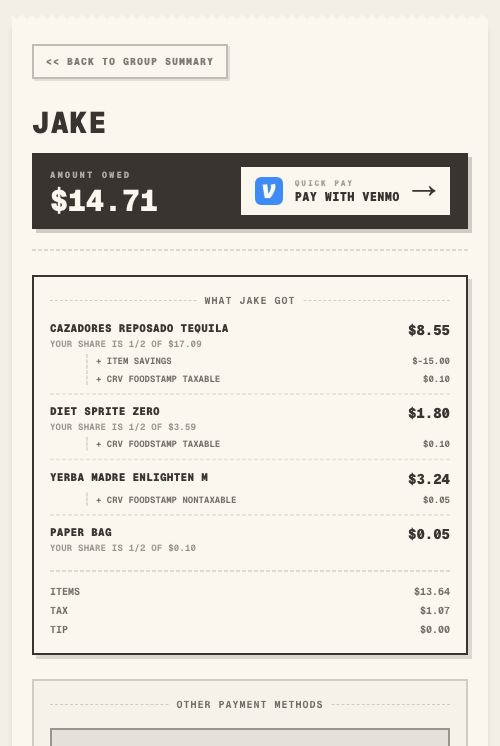
That is why payment handoff matters: after TabChop calculates a personal total, the next action should point people toward the payer’s preferred Venmo, Cash App, or Zelle flow.
The real problem is not only the amount
After a group meal, the host often has to send messages like:
- "You owe me $18.42."
- "My Venmo is..."
- "Put dinner in the note."
- "Can you send it tonight?"
- "Who still has not paid?"
Each extra instruction creates a chance for delay or error.
What payment deeplinking solves
Payment deeplinking reduces the gap between knowing the total and paying it.
In TabChop, the app already knows:
- The participant's personal total
- The receipt merchant
- The host's preferred saved payment method
- The note to attach to the payment
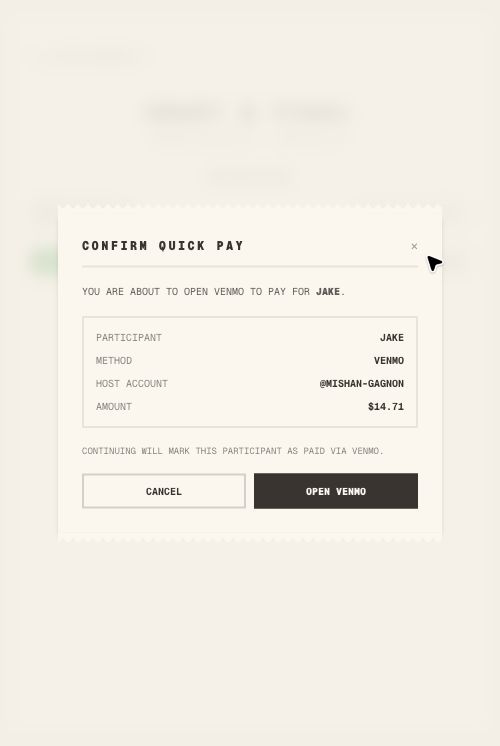
For Venmo, TabChop builds a pay URL with the host handle, amount, and note. For Cash App, it builds a Cash App URL with the host cashtag, amount, and note. For Zelle, where the flow depends on the bank, TabChop shows copyable recipient and amount details.
Why this helps the host
The host paid the full check. They should not also have to manage a mini collections process.
A better repayment flow:
- Participant opens their personal receipt.
- They review the final total.
- They tap the available payment method.
- The payment app opens with the useful details already attached where supported.
- The host can see who has marked payment.
That turns "pay me back later" into a concrete action.
Why this helps participants
Participants also benefit. They do not have to search for the host, copy the wrong handle, or guess the amount.
Venmo's help recommends making sure the recipient identity is correct before sending. Cash App's payment-link announcement describes links that open pre-filled payments with amount and note. Zelle's QR FAQ explains how QR flows can be used when supported by a bank or credit union.
TabChop's job is to connect the receipt total to the payment handoff, so the participant has fewer details to reconstruct and the host does not have to restate how they want to be paid every time.
Zelle needs a different fallback
Not every payment method works like a web link. Zelle is often bank-app dependent, so TabChop uses a copy-friendly modal for the recipient phone and exact amount.
That is still useful because it avoids the two most common mistakes:
- Typing the wrong amount
- Losing the host's payment detail in a chat thread
Common mistakes
Sending only the final total
The payer still needs the recipient and context. A payment note makes the transfer easier to recognize.
Making the host chase every person
The split should create a direct next step for each participant.
Treating Zelle like every other app
Zelle depends on bank support and enrolled contact details. A copyable fallback is often cleaner than pretending every method has the same link behavior.
Quick FAQ
What is payment deeplinking?
It is a link or app handoff that opens a payment flow with useful details like recipient, amount, or note already prepared where the payment platform supports it.
Does TabChop process payments?
No. TabChop calculates the split and hands participants off to the host's selected payment method.
Why require a host payment method?
Because a split should end with a clear way to pay the person who covered the check, using the method they have already said they prefer.
Make repayment part of the split
The best bill split does not stop at "you owe $18.42." It tells the participant how to settle that amount while the receipt context is still fresh.
Key takeaways:
- Payment handoff reduces typing and follow-up.
- Venmo and Cash App can be opened with useful details.
- Zelle gets a copy-friendly fallback for bank-app payment.