Fair Dinner Splits
Split Drinks and Food Fairly
How to keep drinks, appetizers, and entrees from turning one dinner bill into an argument.
Quick answer: To split drinks and food fairly, keep personal drinks with the people who ordered them and split only the shared items among the people who shared them. TabChop makes those assignments explicit on the receipt.
If you are searching for split drinks and food fairly, you are probably trying to avoid the same end-of-meal problem: one person paid, everyone ordered differently, and nobody wants to do awkward math in the group chat.
Restaurant bills get messy because everyone remembers the meal differently. TabChop keeps the split attached to the receipt, so the group can work from line items instead of memory.
Why this search matters
People do not look for bill splitting tools when everything is simple. They search when the check is uneven, the table is large, the receipt is long, or the host needs a clean way to collect payment.
TabChop is built for that specific moment. It starts with the actual receipt, then turns the split into a shared workflow instead of a private calculation.
A better workflow
Use this flow when the receipt arrives:
- Scan the receipt instead of typing every row.
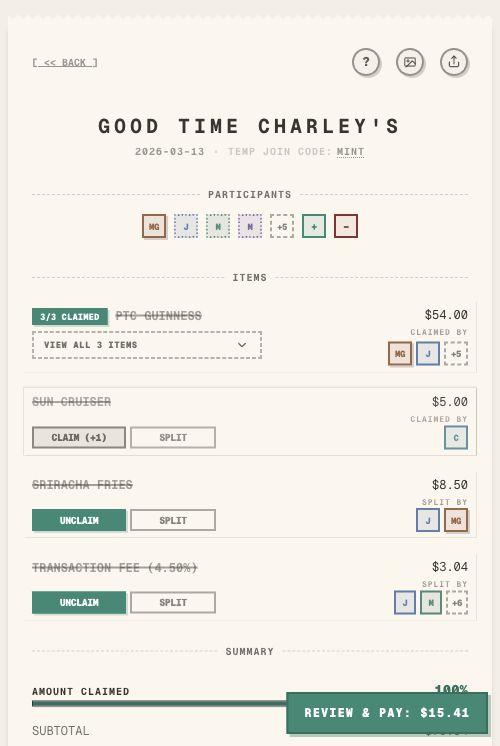
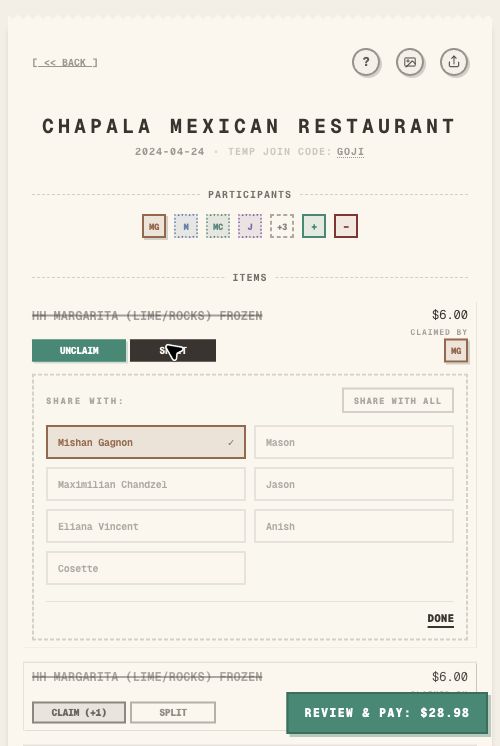
- Let each person claim what they ordered.
- Split shared plates only across the people who shared them.
- Review tax, tip, and final totals before payment.
That keeps the group focused on visible choices instead of estimates. The host does not have to interpret the whole receipt alone, and participants can see why they owe what they owe.
Where TabChop fits
TabChop is strongest when the receipt has details that matter: item names, shared dishes, tax, tip, guests, and payment. A simple calculator can divide a total, but it cannot show who claimed the appetizer or which person still needs to pay.
The useful parts are connected:
- Receipt photo becomes structured rows.
- Rows become claimable items.
- Shared items get assigned to the right people.
- Each participant gets a personal total.
- Payment handoff helps the host get paid back.
Common mistakes
- Defaulting to equal split when orders were uneven.
- Forgetting shared dishes until after people pay.
- Leaving tax and tip out of the final check.
These mistakes are common because the group is usually moving fast. A receipt-based workflow slows down the right part: final review before payment, not manual math at the beginning.
Quick FAQ
Is this only for restaurants?
No. Restaurant checks are the obvious use case, but the same workflow helps with groceries, takeout, bar tabs, coffee runs, and trip receipts.
Do friends need to do math themselves?
No. The point is to let people claim items and review totals rather than calculate each share manually.
What makes TabChop different?
TabChop combines receipt scanning, item claiming, shared-item splitting, guest handling, and payment handoff in one flow.
Bottom line
The best split is the one people can understand quickly. Start from the receipt, make claims visible, and settle while everyone still remembers what happened.
Key takeaways:
- Use the receipt as the source of truth.
- Assign items before collecting payment.
- Give the host a clear path to get paid back.